
What is 2SLGBTQ+?
You may be hearing all kinds of new words and acronyms related to sexuality and wonder what they mean. Although language is often changing to help explain feelings, these kinds of feelings and identities have always existed. Historically, we would have used different words to describe them.
As someone begins to explore who they are, they may try using different words or labels to describe their feelings. We often hear from people who are confused about these labels changing. For example, if someone was once identifying as bisexual but has changed words and is now identifying as a lesbian. This doesn’t mean the person is confused, only that they were on a search to find the label that felt best for them.
It can be hard to keep up with the ever-changing vocabulary. All we can do is try our best and use the words our friends, family, or co-workers ask us to. It is never okay to use these words to name call or label others. If someone tells us they use one of these words then it may be okay to use it to describe them moving forward. Check in with them to be sure! The definitions listed here are generally respectful and acceptable for everyone to use with good intentions.
Common Concepts
2SLGBTQ+
A acronym that stands for “Two Spirit, lesbian, gay, bisexual, transgender, queer and other identities”. Sometimes you will see this expanded as 2SLGBTQIA to include “lesbian, gay, bisexual, transgender, two-spirit, queer, intersex, and asexual” or ordered differently like GLBT. As you can tell, the terms people use continue to grow and so many people use a + sign to include all of the unnamed identities in the acronym. This term is often used to broadly refer to all members of this community.
Gender Identity
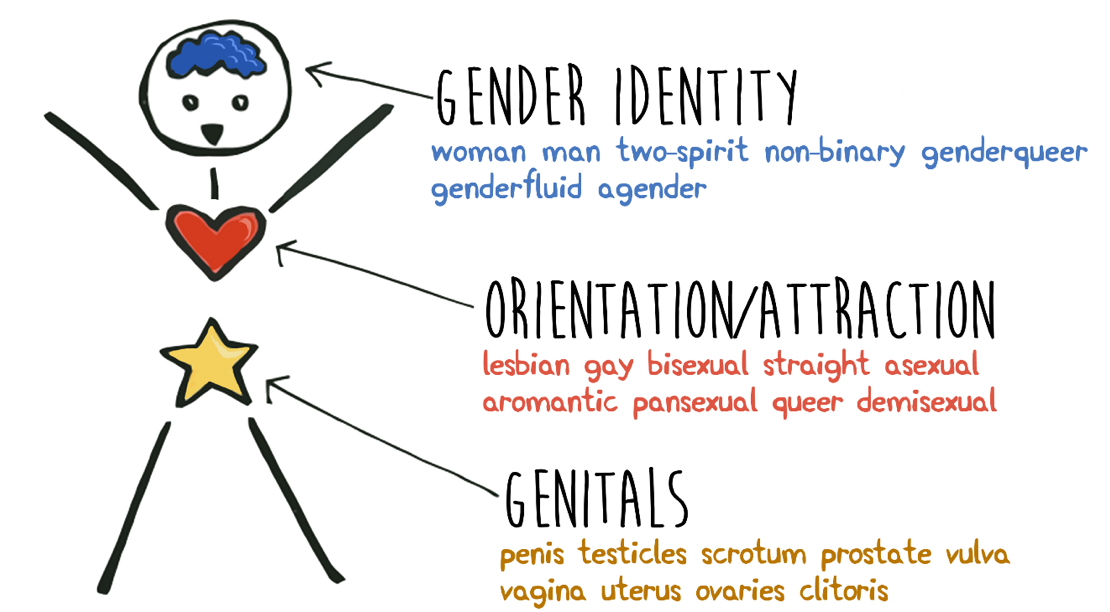
A person’s internal sense of their own gender. This can include feeling like a man, a woman, or another gender outside of these 2 genders. If someone feels like their gender is the same as the gender a doctor assigned them with at birth that person is considered cisgender. If someone feels that their gender is different than what the doctor assigned that person is considered transgender.
Orientation
Labels people use to explain who they are attracted to. Orientation and gender are different from one another (who you are vs. who you like). A person’s gender does not determine who they will be attracted to. Orientation can include different levels of attraction such as: emotional attraction, romantic attraction, sexual attraction, platonic attraction, intellectual attraction.
Sex
At birth, the organs between a person’s legs, called genitals, are used to assign a baby’s sex (male or female). Some babies have genitals that do not fit the categories of male or female. If sexual or reproductive organs fall outside of these categories, the baby is assigned intersex.
Many people agree with the label the doctor assigned them at birth. If you agree, you are considered cisgender. Some people do not feel the label the doctor assigned them at birth fits their gender. If you disagree with the label the doctor assigned you at birth, you are considered transgender.