

On Two-Spirit and Indigenous LGBTQQIA+ Celebration and Awareness Day, we re-commit to our journey of learning and true partnership with Indigenous communities.
We are so lucky to work with Marshall Vielle (they/them) here at the Centre. Marshall started with us in 2019 as a volunteer at Camp fYrefly and has since had a huge impact on our team in a variety of roles. We sat down with Marshall to talk about their journey at the Centre for Sexuality, building programming for Two-Spirit and Indigiqueer people and building trust as the foundation for lasting change.
You’ve been with us on and off for a long time. Tell us a little bit about your current role, but also your journey at the centre and the various roles that you’ve held with us.
I started at the Centre in 2019 as a Youth Leader for Camp fYrefly, our annual 2SLGBTQ+ leadership retreat. It was one of the first times I got to work alongside other Two-Spirit and Indigiqueer people, people that I looked up to and admired from afar. Witnessing them hold space for Queer, Trans, and Two-Spirit youth was incredible, and I knew that it was something I wanted to continue to be part of. Since then, I’ve returned as Artist-in-Residence and taken on an increased leadership role as one of the camp coordinators.
Currently I’m working as the Indigenous Programs Coordinator, where I get the chance to provide capacity-building sessions in our Training Centre and community programming with our Relationship and Sexual Health Education team.
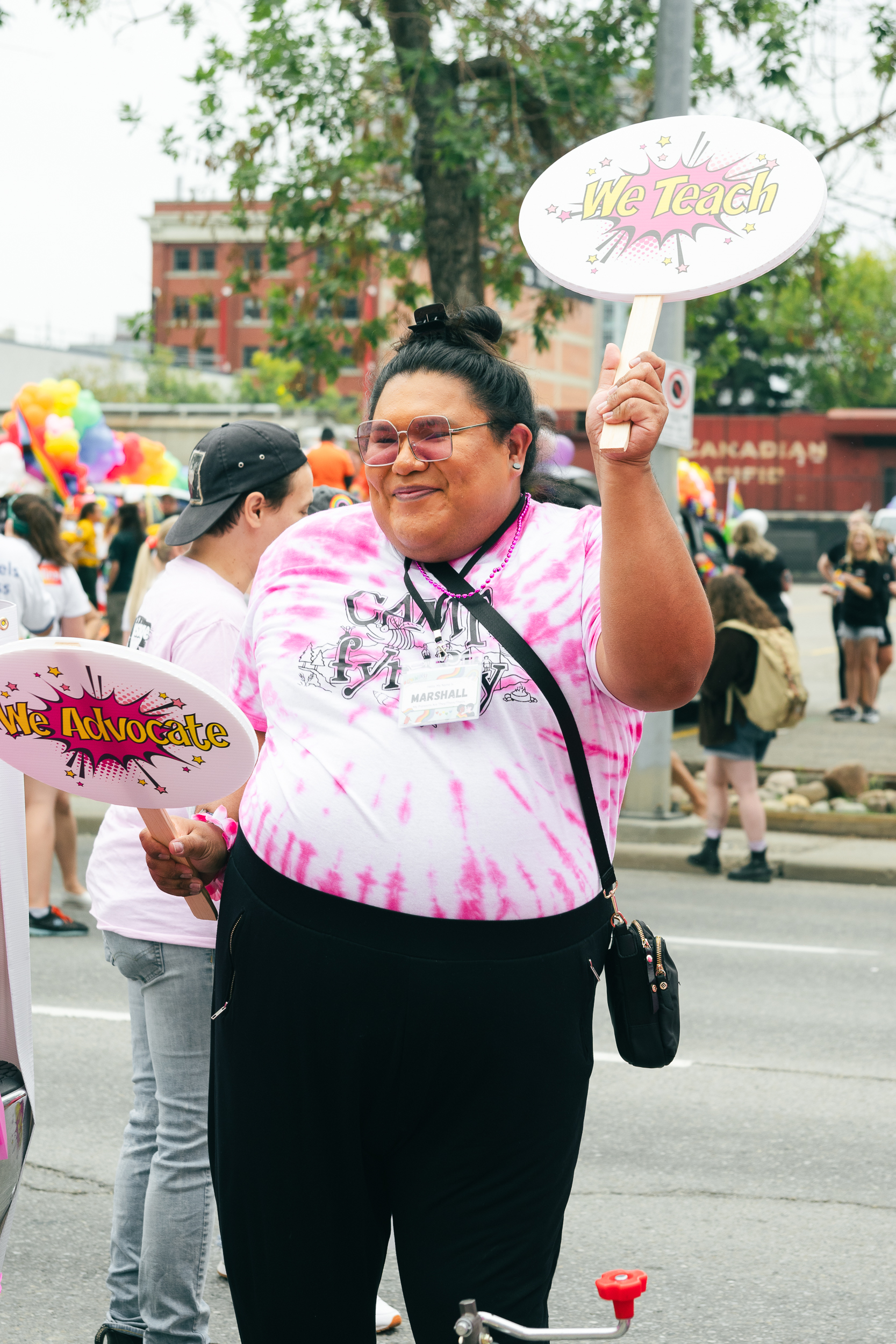
Marshall at the 2023 Calgary Pride Parade
You were instrumental in building our Where the Rivers Meet program at the Centre. How did that come to be?
Following my time at camp, I was selected by the Centre to conduct a needs assessment for Two-Spirit youth throughout Treaty 7. I got the chance to meet one-on-one with Two-Spirit artists, educators, social workers and knowledge keepers to discover what some of the most urgent challenges the community was facing and how a place like the Centre could help them overcome those challenges. The findings were that Two-Spirit people in Treaty 7 needed increased visibility, connection, and education, thus Where the Rivers Meet YYC was formed.
What did you do with the report findings?
One of the report findings identified a desire for Two-Spirit visibility. I worked with community partners to curate an exhibit called Fifty Shades of Brown to showcase the diversity that exists within the Two-Spirit and Indigiqueer community. I wanted to highlight that we, as Two-Spirit people, don’t all look or act or express ourselves in the same way, that’s there’s no one way to be a Two-Spirit or Indigiqueer person.
Another report finding identified a need for increased opportunities to connect. This led to the creation of Indigiqueeries: A Two-Spirit Café Series back in 2022. This was my take on the idea of having a monthly “salon” style gathering for Two-Spirit and Indigiqueer people to connect to likeminded people in the community.
It’s a no-tourist space, meaning it’s designed specifically for Two-Spirit and Indigiqueer people to attend, to allow folks to participate in identity-specific discussions and artmaking. Participants have expressed gratitude in coming to a space that is accessible, central, and where they feel safe. Providing a sober space where we can feed people and meet them where they’re at has been incredibly heartwarming for me. We have several people who regularly show up each month, which proves to me that Indigiqueeries is a soft place to land for many and serves as one of my favourite parts about my job.
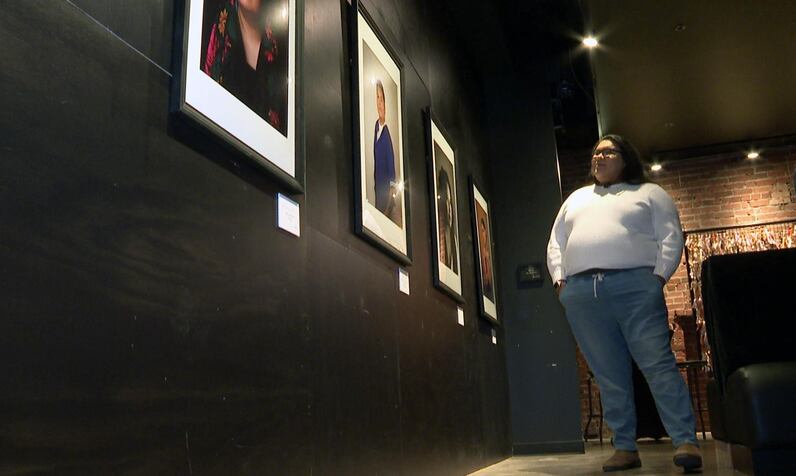
Marshall at 50 Shades of Brown at the Grand Theatre in 2022 (Terri Trembath/CBC)
What about the Centre using other programs to reduce these systemic factors that can harm to 2S and Indigiqueer people?
The last report finding identified increased education on how structural and lateral violence have impacted Two-Spirit and Indigiqueer people. Our Training Centre has been doing capacity-building workshops for professionals for over a decade. I identified a gap in our program offerings, which is how Creating a Culture of Respect for Two-Spirit and Indigiqueer Communities was created.
This workshop shares aspects of gender and sexual diversity from an Indigenous lens and honours the revitalization of Two-Spirit identity and inclusion. It helps teams build knowledge, comfort and skill to create safer, more inclusive environments while deepening their understanding of Two-Spirit and Indigiqueer experiences and perspectives.
March 20 is Two-Spirit and Indigenous LGBTQQIA+ Celebration and Awareness Day. There are lots of days to recognize and acknowledge specific populations throughout the year. What do you think of this? Can it be a vehicle to spark change?
Having days like this is incredible and speaks to the depth at which the broader community is interested in creating change. For some, it’s a chance to pause and reflect; for others, it’s a chance to celebrate. No matter how someone chooses to honour the day, doing something – anything! – to set aside time to recognize and learn about different communities and the people who are part of them leaves me hopeful for a kinder tomorrow.
What can people do in their daily lives to inspire change? Or what about organizations what want to make an impact for Two-Spirit and other under-served populations?
I want to begin by acknowledging that what works for me, or any individual or group or community, may not work for all. Although we as Indigenous people may have shared history and similar values or ways of knowing, there are also aspects of each community that make us unique. Whether it’s specific protocols or ways of doing things, it’s best to approach each community in a good way with an open heart.
I find leaving assumptions we have about certain communities at the door is a great starting point, as well as asking ourselves who is missing from any work we do in community. And when we discover who is missing, doing everything we can to build trust and rapport with those people. Doing our best to create relationships that are meaningful, reciprocal and allow us to see someone and everything they’re bringing as a gift, as a valuable member of our team. Instead of seeing them for the ways in which they can benefit us or our work, we need to see them for the ways in which we can be in service to them.
When it comes to specifically working in 2SLGBTQ+ settings, folks can ensure that there are Two-Spirit people represented at all levels, from the early stages of development to implementation. Whether it’s talking about navigating discrimination for 2SLGBTQ+ students, creating curriculum for relationship and sexual health education or identifying best practices for creating safer spaces, we should ensure that Two-Spirit people are always invited to share their unique perspectives.
And throughout this process, understanding that we can only move at the speed of trust. Building relationships takes time, more time than we often think it will take, but the investment is worth it.