

2SLGBTQ+ folks in rural communities or small cities are often left without affirming healthcare options or safe, fun spaces to connect. That’s why the Centre for Sexuality, alongside community partners, recently launched Friends of Dorothy, a program designed to bridge healthcare gaps, strengthen relationships and build resilient queer community outside of major cities. The first offering of the program took place in Lethbridge and got great feedback, and Medicine Hat is up next in November.
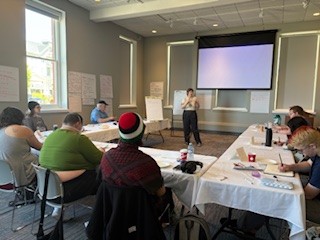
A session in progress at Friends of Dorothy
We sat down with Jason Funkhouser, who leads the program, to learn more about what participants can expect from this big step forward in Alberta queer programming.
“Honestly, this is the first time I’ve seen something like this. Especially in these smaller communities, there’s no program like this that I’ve ever seen in Alberta.”
Q: How did Friends of Dorothy start?
Friends of Dorothy started from the program we’ve been doing here at the Centre for Sexuality for many years now called Totally Outright, which focuses on giving comprehensive sexual health education to 2SGBTQ+ masc-identifying folks.
While Totally Outright has been well received, we recognized a need for more universally queer spaces in rural communities. This led us to develop Friends of Dorothy, a program open to all 2SLGBTQ+ individuals. In planning this expansion, we focused on connecting participants to local services and collaborating with community organizations, including our partner Pro-Choice YQL in Lethbridge.
The name is an ode to how people used to kind of “nod” to queerness by asking: “Are you a friend of Dorothy?” It’s a discreet connection to The Wizard of Oz. It became a thing because Judy Garland is such a gay icon, but I think the themes of the movie like a team of misfits and chosen family also make the name resonate.
Q: What do people learn in the program?
We based it off the content that’s delivered in Totally Outright. There are sessions on health, mental health, sexual health: How do you talk to your healthcare provider? What are ways you can advocate for yourself? What do you do with “trans broken arm syndrome” – that experience when a health care provider attributes unrelated issues to your trans identity, like seeing a broken bone and saying: “that probably happened because you’re on hormones”? There is a lot of stigma in health care. We help prepare people for those conversations so they can have better outcomes.
The other piece that we really wanted to dial in on was building community. This shows up in discussions about navigating conflict and differences within queer communities, but also how we can uplift one another. Some people worry that they’re too queer for their community, or not queer enough. But there is no right way to be queer! The whole idea of being queer is being confidently outside the box.
The program is based in relationship-building at its core. We talk about and teach skills for relationships, communication and boundaries. This can be helpful in personal relationships like friends and family, with a healthcare provider or within the context of the wider queer community.
Q: What is unique about this program?
Honestly, this is the first time I’ve seen something like this. Especially in these smaller communities, there’s no program like this that I’ve ever seen in Alberta. There are such great organizations and practitioners doing one-to-one work, but there is some unique learning that only happens when you share space and exchange information with lots of other people.
For example, when we did Friends of Dorothy in Lethbridge, someone with a chronic illness described their challenges finding care for an issue unrelated to their gender identity. Someone else in the room with the same chronic illness named a health care provider that they had a good experience with and could help. It’s not like we’re here to make a list of all the queer and trans healthcare providers. But when you have community that’s coming in and discussing this, that’s where the learning occurs and connections are made.
When you’re a queer or trans person in a rural or small community, you’re waiting for spaces like this. They’re waiting and looking for opportunities like this. That’s why I think Friends of Dorothy could be an ongoing program, something that adds a lot of value and meets real community needs.
Q: What feedback have you received from the first Friends of Dorothy weekend in Lethbridge?
Overall, feedback has been so positive. Out of the participants that responded to the pre- and post-program surveys, we got 5/5 stars for overall experience from every single participant! I’m really proud of that.
The program can also help folks take the content from theory to action. Jen from Pro-Choice YQL and I worked together prior to my role at the Centre, leading community organizing frameworks in Lethbridge — art builds, protests, vigils — and taught simple frameworks of community organizing. It helps switch people’s mindset from “What’s the problem?” to “What can I do about it?” This helps people feel less overwhelmed by things that can feel really heavy and equips them to take action in ways that feel right to them.
Q: Anything else to highlight about the next session?
“We’re trying to lower barriers to attendance as much as we can so as many people as possible can participate.”
We’re partnering with Safelink Alberta, who will offer STBBI testing throughout the entire weekend. So in addition to getting all this education, you can also just get tested and talk to an actual healthcare provider one-on-one. We’ll also have safer sex supplies and resources from partner organizations.
Other important stuff for people to know if they are on the fence about signing up… The program is completely free. We provide meals and snacks throughout the day. The facility is wheelchair-accessible with gender-neutral bathrooms. We’ll provide transit tickets for folks who need it. And there is a $50 honorarium for people who complete at least 80% of the program. We’re trying to lower barriers to attendance as much as we can so as many people as possible can participate in the weekend.
Friends of Dorothy Medicine Hat takes place November 14–16. Apply online.